Statistical Distributions
TOC
Reference:
Mainly collected from Wikipedia and class notes of the class STAT 5100 in CU Boulder.
Basic knowledge
-
Cumulative distribution function (CDF)
The cumulative distribution function of a real-valued random variable \(X\) is the function given by
\[F_X (x) = P(X \leq x)\]CDF can be find by integrating PDF.
-
Probability density function (PDF)
A function that defines the relationship between continuous random variables and their probabilities. If the random variables are discrete, we call it Probability mass function (PMF).
\[P(X \in [a,b]) = \int_a^b f_X(x)dx\]PDF can be find by differentiating CDF.
\[f(x) \geq 0 \quad , \quad \int_{-\infty}^{\infty}f(x)dx = 1\]Continuous:
\[E[X] = \int_{-\infty}^{\infty}x \cdot f(x)dx\]Discrete:
\[E[X] = \sum_x x \cdot \underbrace{P(X=x)}_\text{f(x)}\] -
Law of total probability
\[P(A) = \sum_n P(A \cap B_n) \text{ or } P(A) = \sum_n P(A \mid B_n) P(B_n)\] -
Bayesian statistics
\[\text{Posterior} = \frac{\text{Likelihood} \times \text{Prior}}{\text{Evidence}}\]Given a prior belief that a PDF is \(p(\theta)\) and that the observations \(x\) have a likelihood \(p(x \mid \theta )\), then the posterior probability is defined as
\[p(\theta \mid x) = \frac{p(x \mid \theta) p(\theta)}{p(x)}\]where \(p(\theta)\) is the normalizing constant and is calculated as
\[p(x) = \int p(x\mid\theta) p(\theta) d(\theta)\] -
Conjugate prior
In Bayesian probability, if the posterior distribution \(p ( \theta \mid x )\) is in the same probability distribution family as the prior probability distribution \(p(\theta )\), the prior and posterior are then called conjugate distributions, and the prior is called a conjugate prior for the likelihood function \(p(x\mid \theta )\).
-
Manually calculate a p-value
The p-value for:
a lower-tailed test is specified by: \(\text{p-value} = P(TS \leq ts \mid H_0 \text{ is true}) = \text{cdf}(ts)\)
an upper-tailed test is specified by: \(\text{p-value} = P(TS \geq ts \mid H_0 \text{ is true}) = 1 - \text{cdf}(ts)\)
\(\text{TS}\) is “Test statistic”, \(\text{ts}\) is the observed value of the test statistic calculated from your sample.
-
Distributions of Certain Sums
- A Sum of Bernoullis is Binomial
- A Sum of Binomials is Binomial
- A Sum of Poissons is Poisson
- A Sum of Geometrics is Negative Binomial
-
Things to know about \(e^x\)
- Lim: \(\lim_{n\rightarrow\infty}(1+\frac{x}{n})^n = e^x\)
- Taylor Series Expansion: \(e^x = \sum_{n=0}^\infty \frac{x^n}{n!} = 1 + x + \frac{x^2}{2!} + \frac{x^3}{3!} + \ldots\)
Common distributions
Symmetric probability distribution
A probability distribution is said to be symmetric if and only if there exists a value \(x_{0}\) such that
\[f(x_{0}-\delta )=f(x_{0}+\delta )\]for all real numbers \(\delta\) , where \(f\) is the PDF if the distribution is continuous or the probability mass function if the distribution is discrete.
Uniform distribution
Notation: \(X \sim \mathrm{Unif}(a,b)\)
PDF:
\[f(x)={\begin{cases}{\frac {1}{b-a}}&\mathrm {for} \ a\leq x\leq b,\\[8pt]0&\mathrm {for} \ x<a\ \mathrm {or} \ x>b\end{cases}}\]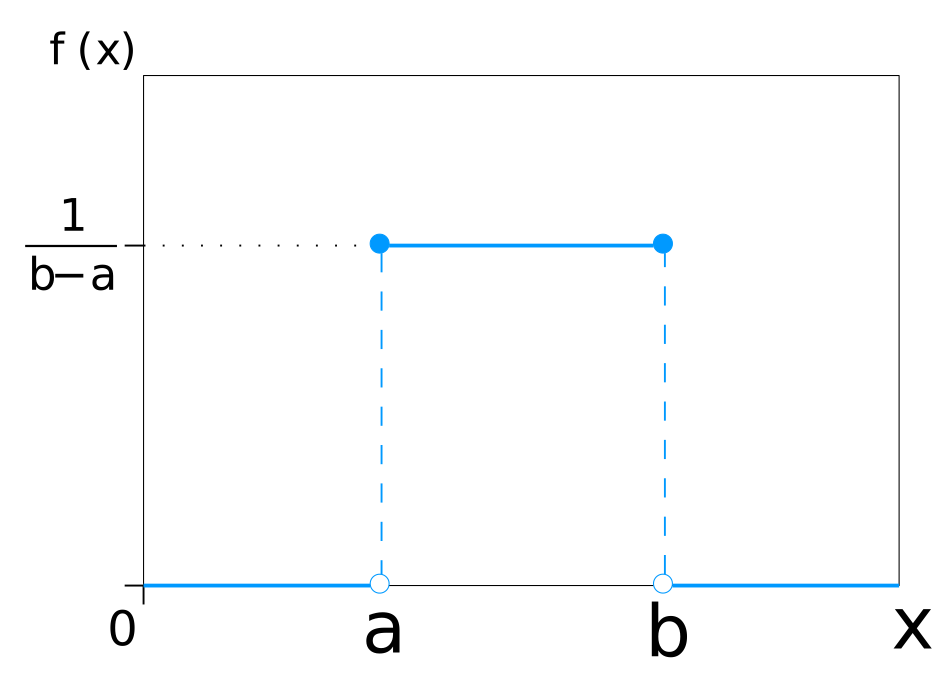
CDF:
\[f(x)={\begin{cases}0&{\text{for }}x<a\\[8pt]{\frac {x-a}{b-a}}&{\text{for }}a\leq x\leq b\\[8pt]1&{\text{for }}x>b\end{cases}}\]
Bernoulli distribution
Notation: \(Bernoulli(p)\) or \(Bern(p)\)
Let \(X\) be a random variable that takes on the values \(1\) and \(0\) with respective probabilities \(p\) and \(1 − p\). Then \(X\) is said to have a Bernoulli distribution with parameter \(p\).
\[{\displaystyle \Pr(X=1)=p=1-\Pr(X=0)=1-q.}\]The PMF of this distribution, over possible outcomes \(x\), is
\[P(X=x)={ \begin{cases} p &{\text{if }}x=1,\\ q=1-p &{\text{if }}x=0.\end{cases}}\]or
\[{\displaystyle P(X=x)=p^{x}(1-p)^{1-x}\quad {\text{for }}x\in \{0,1\}}\]or
\[{\displaystyle P(X=x)=px+(1-p)(1-x)\quad {\text{for }}x\in \{0,1\}.}\]The mean or expected value of the Bernoulli distribution is
\[E[X] = \sum_x x P (X = x) = 0 (1 − p) + 1 p = p\] \[E[X^2] = \sum_x x P (X = x) = 0^2 (1 − p) + 1^2 p = p\]Then the variance of this distribution is
\[\text{Var}[X] = E[X^2] − (E[X])^2 = p − p^2 = p(1 − p)\]The Bernoulli distribution is a special case of the binomial distribution with \(n = 1\).
Binomial distribution
Notation: \(B(n,p)\) or \(bin(n,p)\)
The binomial distribution with parameters \(n\) and \(p\) is the discrete probability distribution of the number of successes in a sequence of \(n\) independent experiments, each asking a yes–no question, and each with its own Boolean-valued outcome: success (with probability \(p\)) or failure (with probability \(q = 1 − p\)).
PMF:
\[P(X=x)={\binom {n}{x}}p^{x}(1-p)^{n-x}\]for x = 0, 1, 2, …, n, where
\[{\displaystyle {\binom {n}{x}}={\frac {n!}{x!(n-x)!}}}\]is the binomial coefficient. The formula can be understood as follows: \(x\) successes occur with probability \(p^x\) and \(n − x\) failures occur with probability \((1-p)^{n-x}\). However, the \(x\) successes can occur anywhere among the \(n\) trials, and there are \({\tbinom {n}{x}}\) different ways of distributing \(x\) successes in a sequence of \(n\) trials.
\[E[X] = np\] \[Var[X] = np(1 − p)\]A single success/failure experiment is also called a Bernoulli trial or Bernoulli experiment, and a sequence of outcomes is called a Bernoulli process; for a single trial, i.e., \(n = 1\), the binomial distribution is a Bernoulli distribution.
Negative binomial distribution
Notation: \(\mathrm {NB} (r,\,p)\) or \(negbin(r,p)\)
\(r > 0\) — number of successes until the experiment is stopped (integer, but the definition can also be extended to reals)
\(p \in [0,1]\) — success probability in each experiment (real)
PMF:
\[{\displaystyle f(x;r,p)\equiv \Pr(X=x)={\binom {x+r-1}{x}}(1-p)^{x}p^{r}}\]Geometric distribution
Notation: \(geom(p)\)
Consider a sequence of independent trials of an experiment where each trial can result in either “Success” (\(S\)) or “Failure” (\(F\)). Let \(0 \leq p \leq 1\) be the probability of success on any one trial. It’s a special case of negative binomial distribution.
Definition 1 (“number of trials” model):
Let \(x\) be the number of trials until the first success. There will be \(x-1\) failures, each with probability \(1-p\)
PMF:
\[P (X = x) = (1 − p)^{x−1} p \text{ for } x \text{ in } \{1, 2, 3, \ldots \}\]Definition 2 (“number of failures” model):
Let \(x\) be the number of failures before the first success. There will be \(x\) failures, each with probability \(1-p\).
PMF:
\[P (X = x) = (1 − p)^{x} p \text{ for } x \text{ in } \{0, 1, 2, \ldots \},\]Poisson distribution
Notation \(Poisson(\lambda)\)
A random variable \(X\) has a Poisson distribution with parameter \(\lambda > 0\) if \(X\) has PDF
\[\begin{aligned} P (X = x) &= {\begin{cases} \frac{e^{−\lambda}\lambda^x}{x!} &, \quad x = 0, 1, 2, \ldots\\ 0 &, \quad \text{otherwise} \end{cases}} \\ &= \frac{e^{−\lambda}\lambda^x}{x!} I_{\{0,1,2,\dots\}}(x) \end{aligned}\]Expectation:
\[\begin{aligned} E[X] &= \sum_x x \cdot P(X=x) \\ &= \sum_{x=0}^{\infty} x \cdot \frac{e^{-\lambda}\lambda^{x}}{x!}\\ &= \sum_{x=1}^{\infty} x \cdot \frac{e^{-\lambda}\lambda^{x}}{x!}\\ &= \sum_{x=1}^{\infty} \frac{e^{-\lambda}\lambda^{x}}{(x-1)!}\\ &= e^{-\lambda} \sum_{x=1}^{\infty} \frac{\lambda^{x}}{(x-1)!}\\ &= \lambda e^{-\lambda} \sum_{x=1}^{\infty} \frac{\lambda^{x-1}}{(x-1)!}\\ &= \lambda e^{-\lambda} \sum_{x=0}^{\infty} \frac{\lambda^{x}}{(x)!}\\ &= \lambda e^{-\lambda} e^{\lambda}\\ &= \lambda \end{aligned}\]Exponential distribution
Notation: \(X \sim exp(\lambda)\)
Let \(\lambda > 0\) be a fixed parameter and consider the continuous random variable with PDF
\[\begin{aligned} f(x) &= {\begin{cases} \lambda e^{-\lambda x} &, \quad x \geq 0\\ 0 &, \quad x < 0 \end{cases}} \\ &= \lambda e^{-\lambda x} I_{[0,\infty)}(x) \end{aligned}\]Claims:
- If \(X_1, X_2, \ldots , X_n \stackrel{iid}{\sim} exp(\lambda)\), \(\sum_{i=1}^{n}X_i \sim \Gamma(n, \lambda)\)
- If \(y = min (X_1, \ldots, X_n)\), \(y \sim exp(n\lambda)\)
CDF:
\[F (x) = P (X \leq x) = {\begin{cases} \int_o^x \lambda e^{−\lambda u} du = 1 − e^{−λx} &, \quad x \geq 0 \\ 0 &, \quad x < 0 \end{cases}}\]Expectation:
\[\begin{aligned} E[X] &= \int_{-\infty}^{\infty}x \cdot f(x)dx \\ &= \int_{-\infty}^0 x \cdot 0 \cdot dx + \int_0^{\infty}x\cdot\lambda e^{-\lambda x}dx \\ &= \frac{1}{\lambda} \end{aligned}\]Tail probability:
\[\bar{F} (x) = P (X > x) = 1 − P (X \leq x) = 1 − F (x) = e^{−λx}.\]The exponential distribution is the only continuous distribution with the lack of memory property.
\[\bar{F}(x+y) = \bar{F}(x)\cdot\bar{F}(y)\]Gamma distribution
Notation:
- Gamma distribution \(\Gamma(\alpha, \beta)\)
- Gamma function \(\Gamma(\alpha)\)
Gamma distribution:
Let \(\alpha > 0\) and \(\beta > 0\) be fixed parameters and consider the continuous random variable with PDF
\[\begin{aligned} f(x) &= {\begin{cases} \frac{1}{\Gamma(\alpha)}\beta^{\alpha}x^{\alpha-1}e^{-\beta x} &, \quad x > 0\\ 0 &, \quad \text{otherwise} \end{cases}} \\ &= \frac{1}{\Gamma(\alpha)}\beta^{\alpha}x^{\alpha-1}e^{-\beta x} I_{(0,\infty)}(x) \end{aligned}\]Note that
\[\begin{aligned} \int_0^{\infty} \beta^{\alpha}x^{\alpha-1}e^{-\beta x}dx &= \int_0^{\infty}(\beta x)^{\alpha-1}e^{-\beta x}\beta dx &, \quad \text{Let } u = \beta x, u : 0 \rightarrow \infty \\ &= \int_0^{\infty}u^{\alpha-1}e^{-u}du \\ &= \Gamma(\alpha) \end{aligned}\]\(\alpha\) is known as a shape parameter and \(\beta\) is known as an inverse scale parameter.
Gamma function:
The pdf is given in terms of the gamma function which is defined, for \(\alpha > 0\) as \(\Gamma(\alpha) := \int_0^{\infty} x^{\alpha -1} e^{-x}dx\). (\(:=\) is “defined as”)
Properties of Gamma function:
- For \(\alpha >1\), \(\Gamma(\alpha) = (\alpha-1)\Gamma(\alpha-1)\)
- If \(n\geq 1\) is an integer, \(\Gamma(n) = (n-1)!\)
- \(\Gamma(1)=1\) since \(0!=1\) or \(\Gamma(1) = \int_0^{\infty} x^{1 -1} e^{-x}dx = \int_0^{\infty} e^{-x}dx = 1\)
Inverse-gamma distribution
Notation: \(X \sim \mathrm{Inv}\Gamma(\alpha, \beta)\)
\[{\displaystyle f(x;\alpha ,\beta )={\frac {\beta ^{\alpha }}{\Gamma (\alpha )}}(\frac{1}{x})^{\alpha +1}e^{\left(-\beta \frac{1}{x}\right)}} \text{ , for } x > 0\]Beta distribution
Notation: \(Beta(\alpha, \beta)\)
A family of continuous probability distributions defined on the interval \([ 0 , 1 ]\) in terms of two positive parameters, denoted by alpha (\(\alpha\)) and beta (\(\beta\)), that appear as exponents of the variable and its complement to \(1\), respectively, and control the shape of the distribution.
Mean:
\[E[X] = \frac{\alpha}{\alpha + \beta}\]PDF:
\[\begin{align*} f(p;\alpha, \beta) &= \frac{(\alpha + \beta -1)!}{(\alpha -1)!(\beta-1)!} p^{\alpha-1}(1-p)^{\beta-1} \\ &\propto p^{\alpha-1}(1-p)^{\beta-1} \end{align*}\]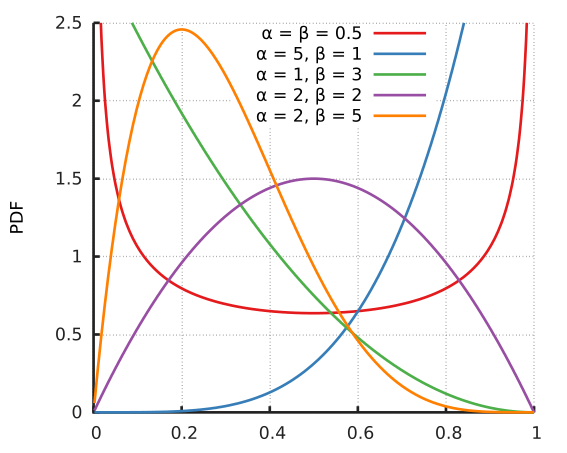
CDF:

In Bayesian inference, the beta distribution is the conjugate prior probability distribution for the Bernoulli, binomial, negative binomial and geometric distributions.
Normal distribution
Notation: \(X \sim \mathcal{N}(\mu, \sigma^2)\)
PDF:
\[{\displaystyle f(x)={\frac {1}{\sigma {\sqrt {2\pi }}}}e^{-{\frac {1}{2}}\left({\frac {x-\mu }{\sigma }}\right)^{2}}}\]